
San Diego apartment vacancy hits historic highs as landlords offer up to 10 weeks free rent. Explore 2026 rental trends, construction, and investor impacts.
San Diego has long been recognized as one of the nation’s most competitive and expensive rental markets. For years, apartment owners benefited from strong demand, limited housing inventory, and steadily increasing rents. But in 2026, the rental landscape looks noticeably different.
Drive through Hillcrest, North Park, Downtown San Diego, or Mission Valley, and you’ll see something that was relatively uncommon just a few years ago: large banners advertising “First Month Free,” “No Security Deposit,” and other move-in specials. We’ve witnessed this firsthand while driving through Hillcrest near a property we recently purchased. New apartment communities are competing aggressively for tenants, and the incentives are difficult to miss.
Recent reporting from CoStar and the San Diego Union-Tribune confirms that these promotions reflect a broader shift across the San Diego multifamily market. The county is experiencing one of its largest waves of apartment construction in more than two decades. Vacancy rates have climbed, rental growth has slowed dramatically, and landlords are increasingly prioritizing occupancy over higher rents.
For San Diego multifamily investors, these trends raise an important question: Is this a temporary adjustment as new construction gets absorbed, or a more significant change in the economics of owning rental property in San Diego?
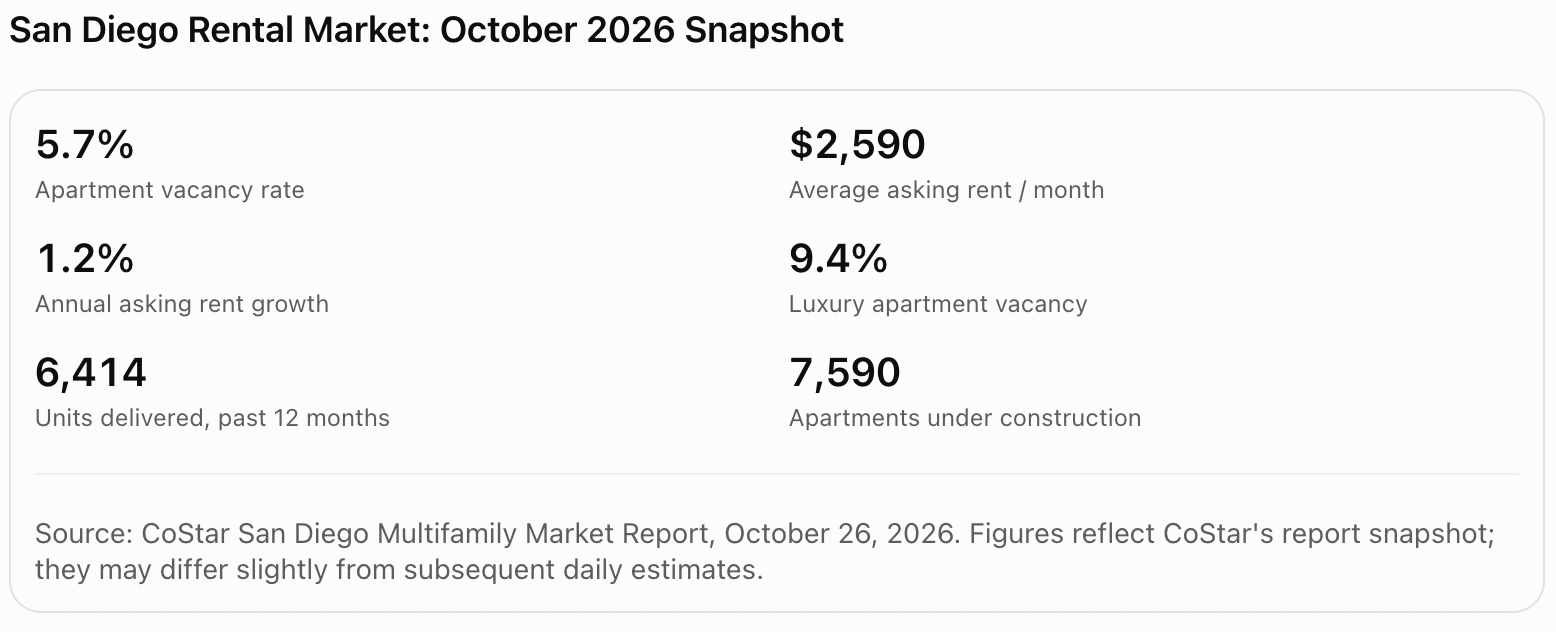
The most important takeaway isn’t simply that vacancy is higher. It’s that the relationship between asking rents, effective rents, and operating expenses is changing, potentially affecting cash flow, property valuations, and investment strategies throughout San Diego County.
1. San Diego Apartment Vacancy Rates Reach Historic Levels.
One of the most significant changes in the San Diego rental market is the increase in apartment vacancies. According to CoStar’s October 26, 2026, report, the countywide apartment vacancy rate stands at approximately 5.7%, compared with 2.7% in 2021. That represents a substantial shift in just five years.
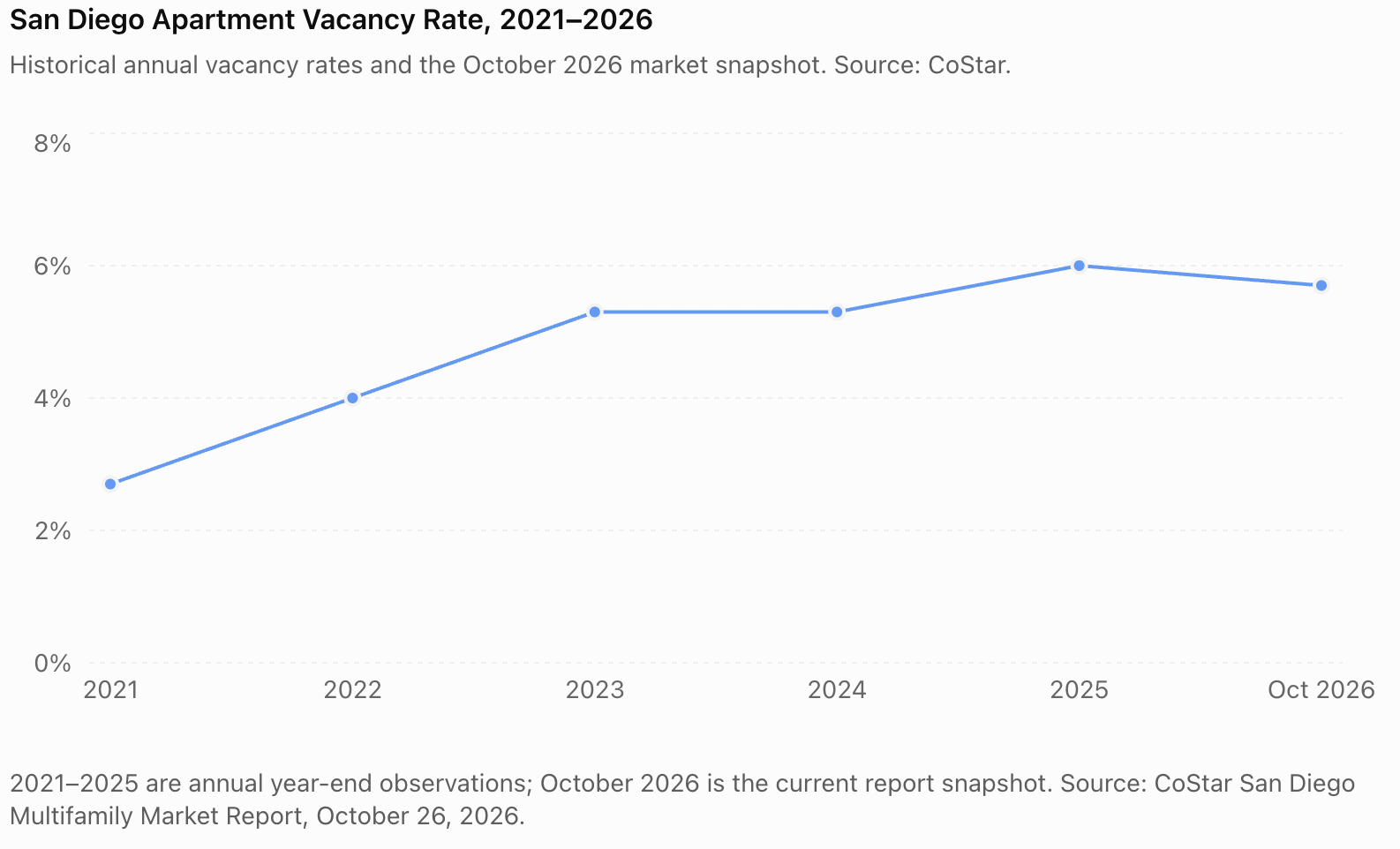
Vacancy reached approximately 6.2% during 2026 before improving as leasing activity accelerated. That improvement is encouraging, but today’s vacancy rate remains above the market’s longer-term historical average of approximately 4.6% to 4.7%. There is an important distinction here: San Diego is still leasing apartments. In fact, CoStar reports that approximately 6,449 units were absorbed over the past 12 months, slightly exceeding the 6,414 apartments delivered during the same period.
This suggests that demand hasn’t disappeared. Rather, new apartment construction has increased competition and given prospective tenants significantly more options. CoStar’s September 17 analysis also identified the elevated vacancy environment as the result of a major construction cycle.
2. Luxury Apartment Buildings Are Feeling the Most Pressure
Not all San Diego rental properties are experiencing the same market conditions. The greatest vacancy pressure is concentrated in newer, higher-end apartment communities
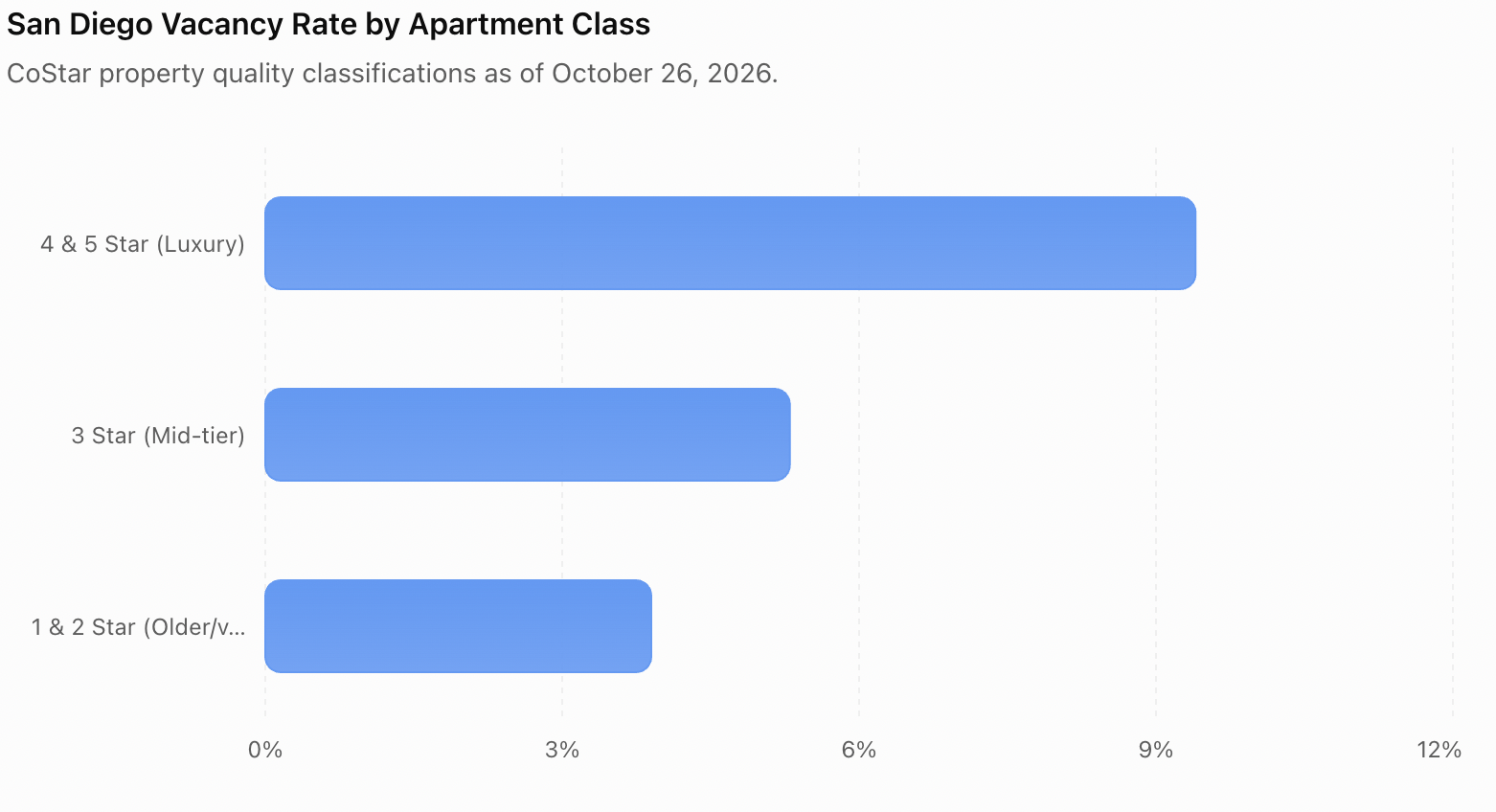
Luxury apartment properties currently have a vacancy rate of 9.4%, compared with just 3.9% for older, more affordable apartment buildings. This difference is especially significant for San Diego multifamily investors. Newly constructed communities frequently offer amenities such as rooftop decks, fitness centers, coworking spaces, resort-style pools, and modern interiors. However, those amenities also come with higher rental rates and operating costs.
As these communities compete for a limited pool of qualified renters, they are increasingly offering substantial leasing incentives. Meanwhile, older apartment buildings with more attainable monthly rents may appeal to renters who are becoming more price-sensitive. For owners of smaller multifamily properties, particularly duplexes, triplexes, and fourplexes, this provides a degree of insulation from direct competition with luxury developments.
However, that protection isn’t absolute. When a brand-new apartment building effectively lowers its rent through concessions, it can begin competing with older properties that previously occupied a lower price bracket.
This is one reason rental competition has spread beyond the luxury segment.
3. Free Rent and Move-In Specials Are Becoming the New Normal
Perhaps the most visible indication of changing rental conditions is the prevalence of concessions. According to CoStar, nearly 40% of surveyed San Diego apartment properties offered incentives during the third quarter of 2026, roughly three times the historical norm. Common rental concessions now include one month of free rent, reduced move-in costs, parking incentives, and leasing bonuses. Some newly constructed apartment communities are advertising up to 10 weeks of free rent.
At AMLI Aero in Serra Mesa, the San Diego Union-Tribune reported offers of up to 10 weeks free rent and complimentary parking for qualifying leases. These offers demonstrate just how competitive the apartment leasing environment has become.
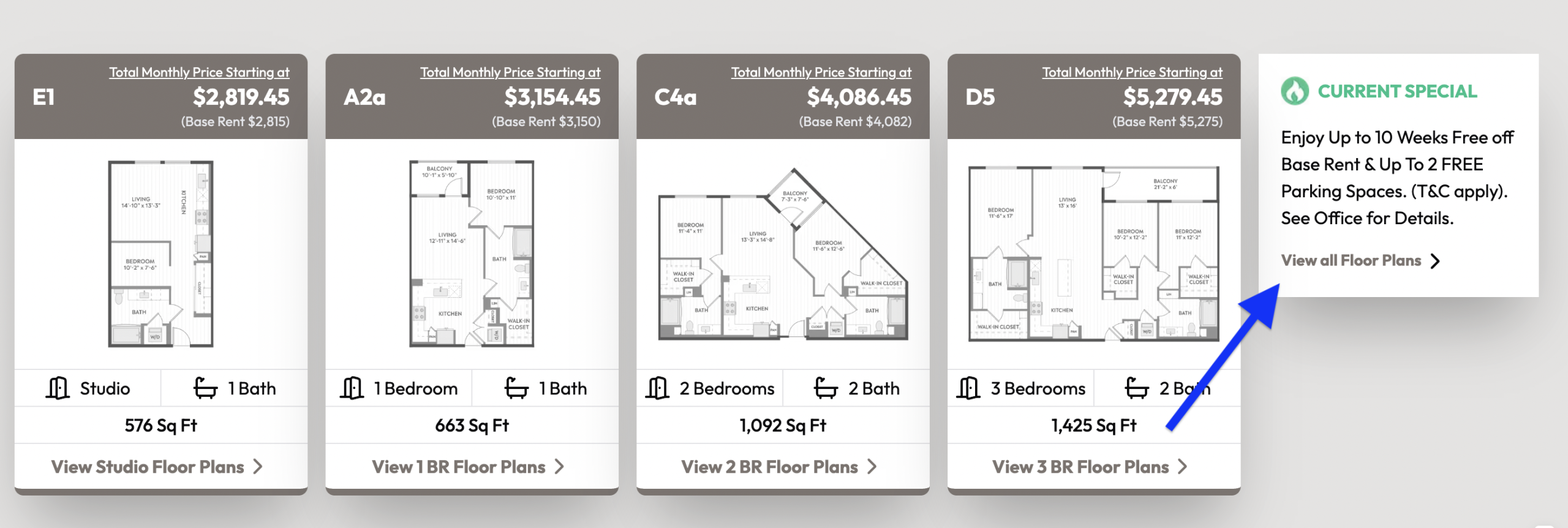
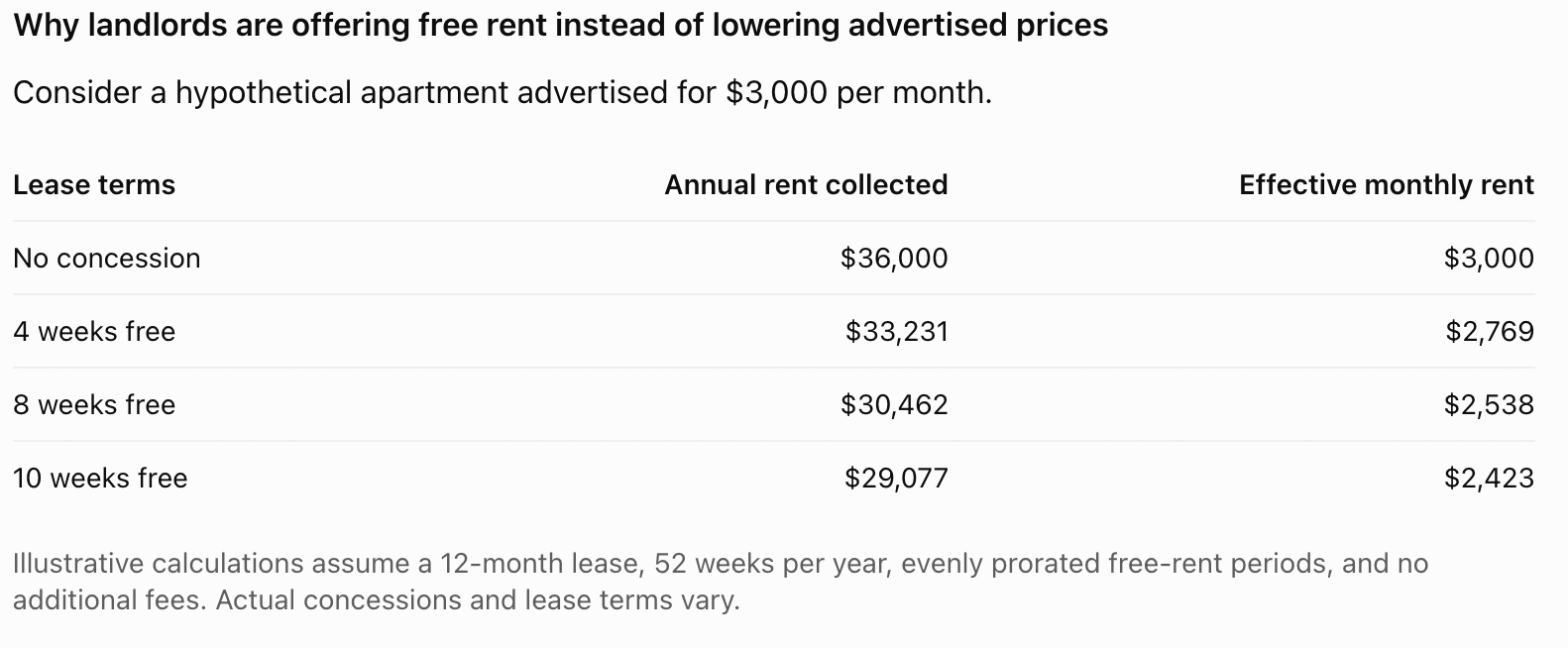
A tenant receiving 10 weeks free on a $3,000 apartment is effectively paying approximately $2,423 per month during that initial lease term. That’s a discount of approximately 19%.
From the landlord’s perspective, offering a temporary concession may be preferable to permanently lowering the advertised rental rate, particularly if they anticipate stronger renewal pricing in the future. However, concessions still affect actual cash flow.
They can also complicate underwriting for investors who rely on advertised rents rather than the income a property is actually collecting. Asking rents are rising, but effective rents tell a different story
CoStar’s October 26 report provides a particularly useful comparison.
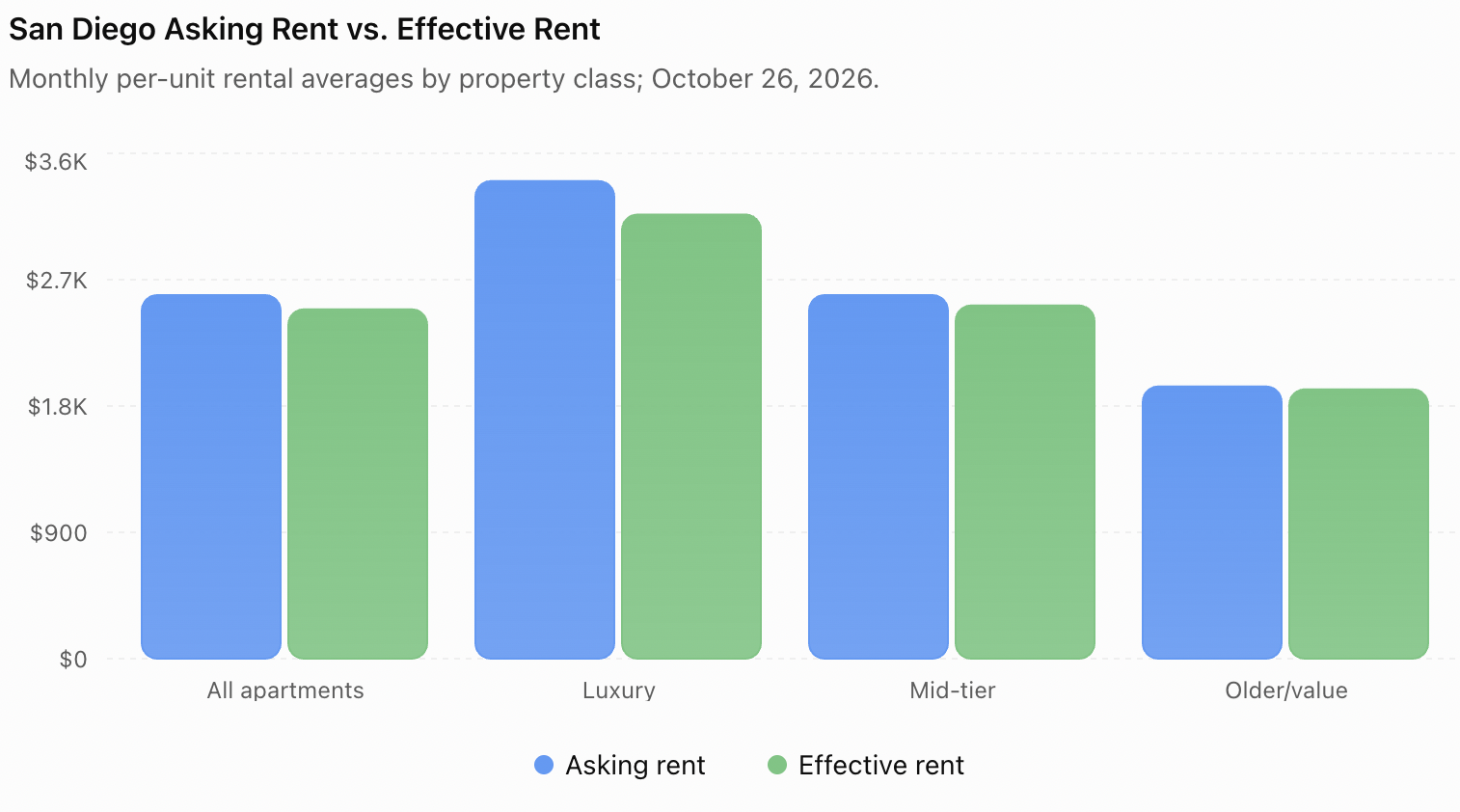
Across San Diego, CoStar estimates average asking rent at $2,590 per month compared with effective rent of approximately $2,489. That’s a difference of $101 per month, or $1,212 annually per unit. On a 20-unit apartment building, that difference would represent $24,240 annually if every unit performed at those averages throughout the year.
These are market-wide averages, not a forecast for any particular property, but the distinction is essential. For multifamily investors, effective rental income, not simply advertised rental income, is what ultimately supports the property’s net operating income and value.
4. Hillcrest, North Park, Mission Valley and Downtown: Where Construction Is Changing the Market
Much of San Diego’s new apartment development has been concentrated in urban neighborhoods where zoning changes and transit-oriented development have allowed greater density. Hillcrest, North Park, University Heights, Downtown San Diego, and Mission Valley have seen significant development activity.
These neighborhoods remain desirable places to live, but the sheer number of new apartments entering the market has created increased competition.
Hillcrest and the Balboa Park submarket
The leasing signs we’ve noticed around Hillcrest are consistent with broader development trends.
CoStar reports that the Balboa Park submarket, which includes Hillcrest and several neighboring communities, has:
– Approximately 34,507 existing apartment units.
– 1,186 units delivered over the previous 12 months.
– Another 2,524 units under construction.
– A 5.6% vacancy rate.
That represents a substantial pipeline in a relatively concentrated geographic area. Several additional apartment communities are scheduled for completion over the coming years, including projects in Hillcrest, Bankers Hill, and North Park. The concentration of construction could keep rental competition elevated, particularly among newly built studio and one-bedroom apartments.
Mission Valley
Mission Valley has experienced an even larger wave of recent apartment deliveries.
CoStar reports approximately 2,018 apartments delivered over the past year, with another 2,108 under construction. Its vacancy rate stands at 7.8%. While Mission Valley benefits from employment access, shopping, transportation, and newer housing options, the volume of competing properties has made rent growth more challenging.
Downtown San Diego
Downtown has the highest vacancy rate among CoStar’s major San Diego submarkets, reaching 10.7%. Many of Downtown’s newer properties compete for similar renters, frequently offering luxury amenities and higher-end finishes.
Large concessions can materially reduce the effective cost of renting these apartments.
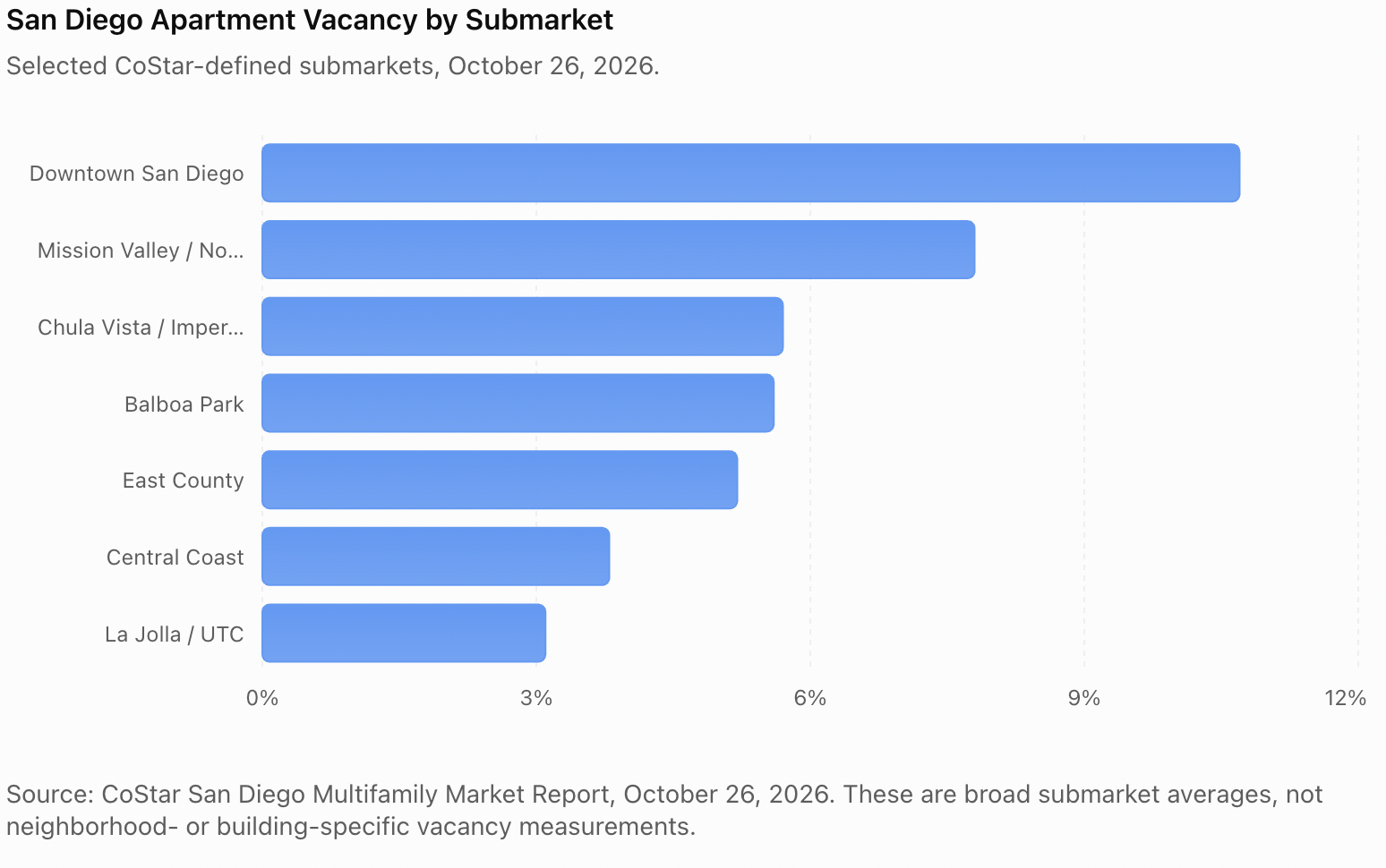
Interestingly, several coastal submarkets have experienced much tighter vacancy, including La Jolla/UTC at 3.1% and the Central Coast at 3.8%. This reinforces an important principle of multifamily investing: San Diego is not one uniform rental market. Neighborhood-level inventory, construction activity, property quality, and tenant demographics all influence rental performance.
5. San Diego Apartment Construction Is at a 20-Year High
The primary driver behind today’s rental competition is an extraordinary increase in apartment supply. San Diego experienced approximately 6,927 apartment completions in 2025, according to the recent Union-Tribune article, and CoStar anticipates roughly 6,400 market-rate apartment deliveries during 2026. The precise totals vary depending on the reporting period and property coverage, but the broader trend is clear.
The region is experiencing its most significant apartment construction cycle in more than two decades.
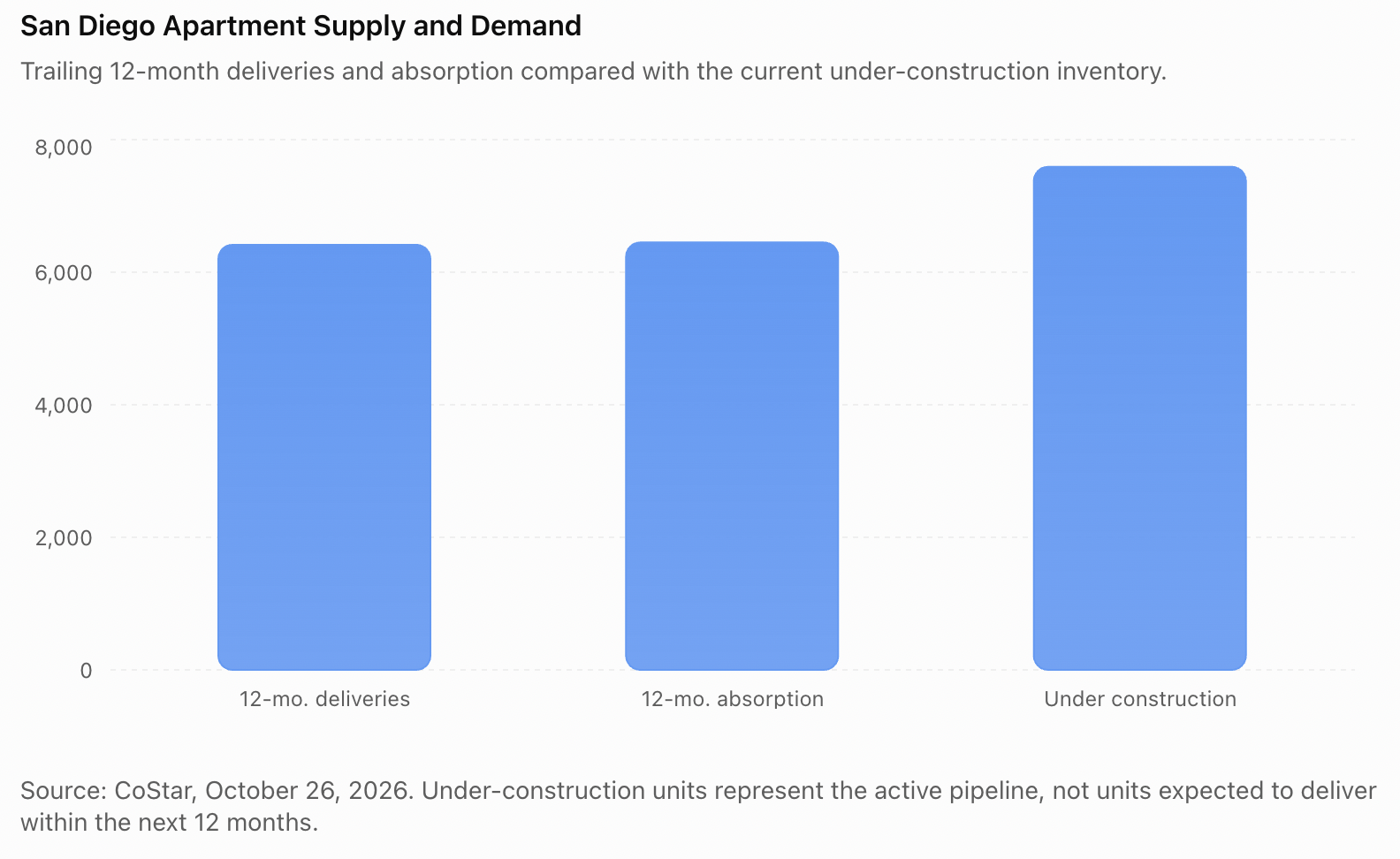
Will apartment construction slow in 2027? There are signs that new construction will moderate. CoStar currently tracks approximately 7,590 units under construction, a smaller pipeline than the region has carried at certain points during the current development cycle. However, thousands of additional apartments will still enter the market as projects are completed.
Large developments in Mission Valley, Chula Vista, and central San Diego are expected to continue affecting the rental market through 2027 and beyond. Even if construction slows, landlords will need time to absorb the inventory already delivered.
This is why CoStar expects rent concessions to remain widespread into 2027, with meaningful rental growth remaining relatively limited in the near term.
6. What Does Rising Vacancy Mean for San Diego Multifamily Property Values?
For apartment investors, the most important consequence of slower rental growth is its potential effect on net operating income (NOI). Multifamily property values, particularly for buildings containing five or more units, are heavily influenced by the income a property generates. When rents remain flat while expenses continue to rise, an owner’s NOI can decline, even without a significant increase in vacancy.
Insurance, property taxes, maintenance, utilities, and labor costs have continued placing pressure on operating budgets. That creates a challenging environment for owners who purchased buildings assuming annual rent increases of 3% to 5%.
How rental concessions can affect apartment values
Consider a hypothetical 10-unit San Diego apartment building where each unit rents for $2,500 per month.
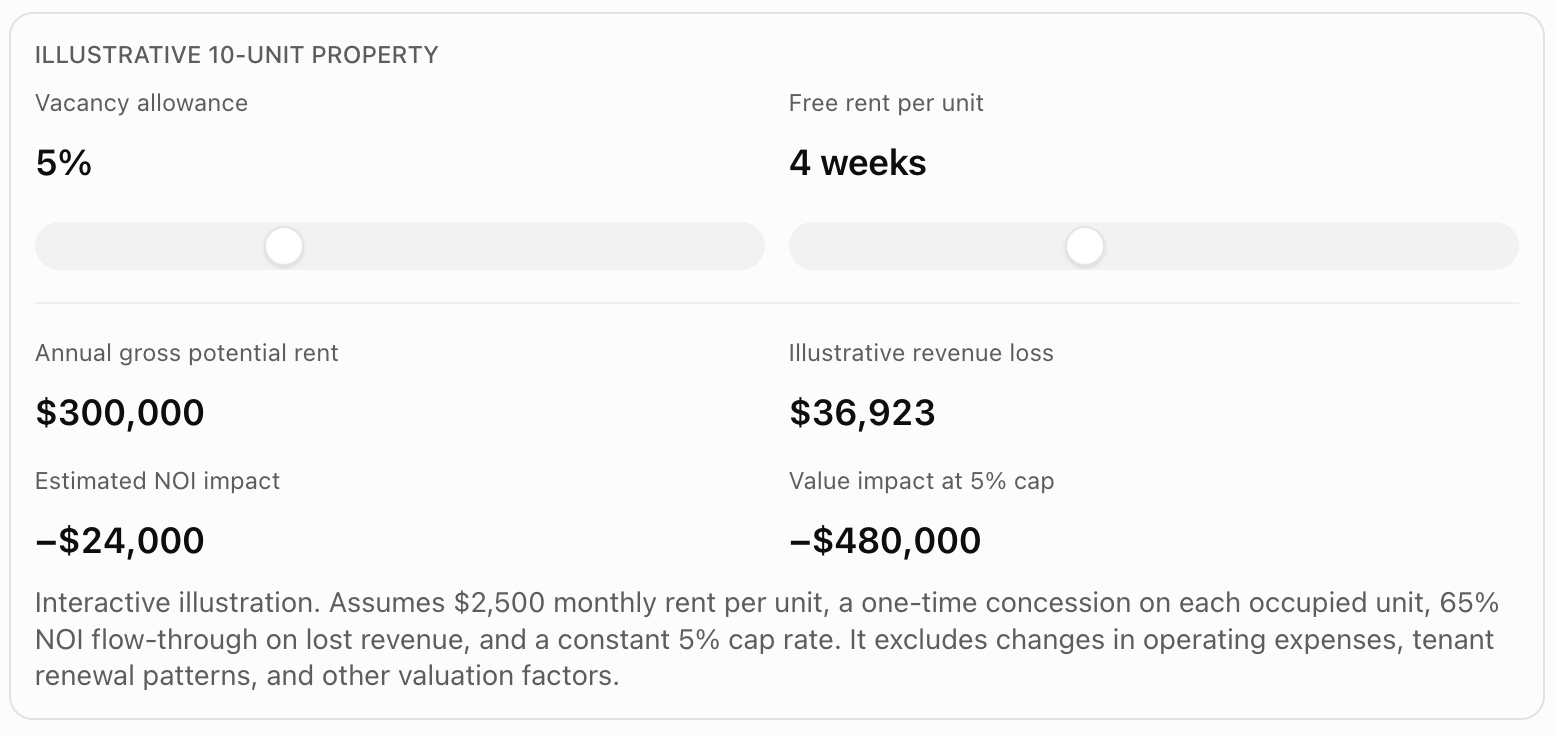
Small adjustments in vacancy and rental income can substantially change a property’s value when capitalized. This is particularly important for value-add investments where future rental increases are a major part of the investment strategy.
Buyers should carefully evaluate achievable market rents, concession-adjusted comparables, vacancy assumptions, and the costs associated with tenant turnover.
Is San Diego multifamily investment activity slowing?
Despite softer rental fundamentals, investment activity has shown signs of improvement. CoStar reports approximately $2.7 billion in market-rate apartment transactions over the past 12 months, with third-quarter 2026 sales volume reaching its highest level in five years. There continues to be investor demand for well-located San Diego apartment properties.
However, buyers are paying closer attention to current income, achievable rents, financing costs, and the risk of additional competing supply.
7. Why Smaller San Diego Apartment Buildings May Have an Advantage
The current environment highlights some of the differences between institutional luxury apartment developments and smaller multifamily properties. Many two-to-four-unit properties in neighborhoods such as North Park, Normal Heights, Hillcrest, South Park, La Mesa, and coastal San Diego offer features that can differentiate them from large apartment communities.These may include larger floor plans, private outdoor areas, individual entrances, fewer shared amenities, and more residential surroundings.
CoStar also notes that new apartment construction has increasingly favored studios and one-bedroom units. Larger two- and three-bedroom floor plans may face a different competitive environment, particularly when they provide features that appeal to longer-term tenants.
That doesn’t mean small multifamily owners are immune to rising vacancy. Rather, it reinforces the importance of understanding what makes each rental property competitive.
For example, an older two-bedroom apartment with parking, outdoor space, and a competitive monthly rent may appeal to a different renter than a luxury studio offering eight weeks free. The strength of a property’s location, layout, condition, and tenant base remains essential.
8. Should San Diego Landlords Lower Rents or Offer Concessions?
There isn’t a universal answer. For an owner with an otherwise well-performing property, a temporary concession may help reduce vacancy without permanently resetting the advertised rental rate. For another owner, a modest rent reduction may attract a larger pool of qualified renters and ultimately produce better results.
The correct decision depends on the property’s financial performance and competing inventory.
At ACI Apartments, we believe owners should focus on several considerations when evaluating their rental strategy:
– Evaluate effective rents. Compare what competing properties are actually collecting after incentives rather than relying exclusively on advertised rents.
– Understand the cost of vacancy. A prolonged vacancy may cost more than a modest rental adjustment.
– Monitor competing developments. Newly constructed apartments can affect rental demand even when their advertised rates are significantly higher.
– Prioritize tenant retention. Turnover can create additional expenses through lost rent, repairs, marketing, and leasing costs.
– Reevaluate pro forma assumptions. Investors should avoid relying on aggressive rent growth when underwriting acquisitions in today’s market.
In some circumstances, maintaining occupancy and predictable cash flow may be more valuable than pursuing the highest possible asking rent.
9. San Diego Rental Market Forecast: What to Expect in 2027
Despite the current challenges, there are reasons to remain cautiously optimistic about San Diego’s longer-term rental fundamentals. The region continues to benefit from its coastal location, universities, military installations, healthcare sector, and barriers to new housing development. At the same time, high housing costs and affordability pressures are unlikely to disappear.
CoStar anticipates that new supply and rental demand may move toward a healthier balance during 2027 as the development pipeline gradually moderates. Its October 2026 market report projects a year-end vacancy rate of approximately 5.4% for 2027, compared with an estimated 5.7% at the end of 2026. Annual asking rent growth is projected at approximately 2.0% in 2027.
These forecasts suggest gradual stabilization rather than a rapid return to the rent increases experienced during the pandemic. San Diego’s long-term housing shortage remains a fundamental consideration. A concentrated wave of new luxury development does not necessarily resolve the broader need for attainable housing throughout the region.
For investors, this distinction is important.
A market can experience elevated vacancy in newly constructed luxury buildings while continuing to face a structural shortage of affordable rental housing.
Final Thoughts: A Changing Market Creates Both Challenges and Opportunities
San Diego’s rental market has changed substantially since the rapid rent increases of 2021 and 2022. The growing number of signs advertising free rent and reduced move-in costs reflects a more competitive leasing environment. Vacancy has increased, rent growth has slowed, and developers are working to absorb thousands of newly constructed apartments.
For existing landlords, the priority is protecting occupancy, controlling expenses, and understanding how changing rental conditions affect property performance.
For buyers, the softer rental environment may create opportunities to acquire properties with more realistic income assumptions and identify long-term value where demand remains resilient.
And for sellers, accurate pricing and a clear understanding of current rental trends are increasingly important.
While San Diego’s multifamily market is experiencing a period of adjustment, well-located apartment buildings with sustainable income and strong rental appeal continue to attract investor interest.
At ACI Apartments, we’ve specialized in San Diego multifamily investment properties for more than 42 years. We closely monitor rental trends, apartment vacancies, transaction activity, and new construction to help property owners and investors make informed decisions. Whether you’re considering selling an apartment building, evaluating a 1031 exchange, or looking for your next investment opportunity, we’re here to help you understand what today’s market means for your property.
Contact ACI Apartments for a complimentary valuation of your San Diego multifamily investment property.
Get a confidential property valuation
Find us on homes.com
Sources and research
The article above is based on ACI Apartments’ CoStar-licensed research, the October 2026 reporting supplied, and supporting industry publications.
1. CoStar — San Diego Multifamily Market Report, October 26, 2026. Pages 2–7 cover vacancy and rent performance; pages 11–14 cover construction; pages 26–27 contain submarket comparisons.
2. CoStar: San Diego Asking Rents Trip Heading Into Fall, October 2, 2026.
3. San Diego Union-Tribune — “10 Weeks Free Rent? Lackluster San Diego Rental Market Has Deals.” October 2026 article supplied for this analysis.
4. CoStar: Apartment Demand Shows Signs of Improvement in San Diego, September 17, 2026.