
Under-market rents don’t just reduce monthly income, they directly compress your valuation, increase buyer leverage, and shift upside away from you and into the buyer’s hands. San Diego apartment valuation strategy is an in-depth process but it starts with your gross scheduled income.
For years, we’ve worked alongside San Diego apartment owners who believed their buildings were performing well; low vacancy, stable tenants, minimal turnover, only to discover at valuation that their income positioning was materially suppressing their exit price.
This is not a criticism of property management. There are excellent operators in our market. But it’s important to recognize something fundamental:
Property management is operational.
Ownership is strategic.
When the two aren’t aligned around long-term value creation, equity erosion can happen slowly and quietly.
The Occupancy vs. Value Disconnect
Managers are often measured on:
Tenant retention
Minimal turnover
Smooth operations
Low vacancy
Owners should be focused on:
Market rent alignment
Gross Scheduled Income (GSI) growth
Debt service coverage (DSCR) strength
Exit positioning
“Low to no vacancy” sounds great. But lenders will underwrite 5% vacancy regardless. Turnover is part of ownership. Where owners get hurt is when rents fall materially below market in the name of stability.
Vacancy is not the enemy. Chronic under-market rents are when it comes to San Diego apartment valuation strategy.
What We’re Seeing in the Market
Across multiple properties and management structures, we consistently see:
Rents not proactively adjusted toward market
Immediate rent reductions after 2–3 weeks on market
Limited use of platforms like Facebook Marketplace
Refusal to accept Zillow applications
Restricted showing windows
Emphasis on tenant retention over income growth
None of these practices are inherently wrong. They can absolutely serve an operational model.
But when rents drift below demand, the financial consequences compound especially in today’s lending environment. For buildings that have been managed for 10-15 years we are seeing rents 30-35% below market.
The Financial Impact
Today’s buyers are facing:
Higher interest rates
Stricter DSCR requirements (often 1.25+ in practice)
Heavier lender scrutiny on actual in-place income
Large down payment requirements
Across San Diego County:
C-Class: 35–40% down
B-Class: 40–50% down
A-Class: 50–65% down
That means buyers must bring substantial equity. Because of that, buyers are increasingly valuing based on actual income performance, not pro forma projections.
The Residual/Upside Method Is Weak in This Market
Historically, buyers could justify higher pricing using a residual method of appraisal.
In today’s environment, that logic is tightening:
Rental laws continue to restrict aggressive increases.
Tenant protections are expanding.
Cost of capital is high.
Lenders are skeptical of speculative upside.
When rents are under market, the upside primarily benefits the buyer, not the seller.
Example of Income Impact on Value
Assume:
Lender standard expenses
Minimum 1.20 DSCR target (many lenders now look for stronger)
45% down payment
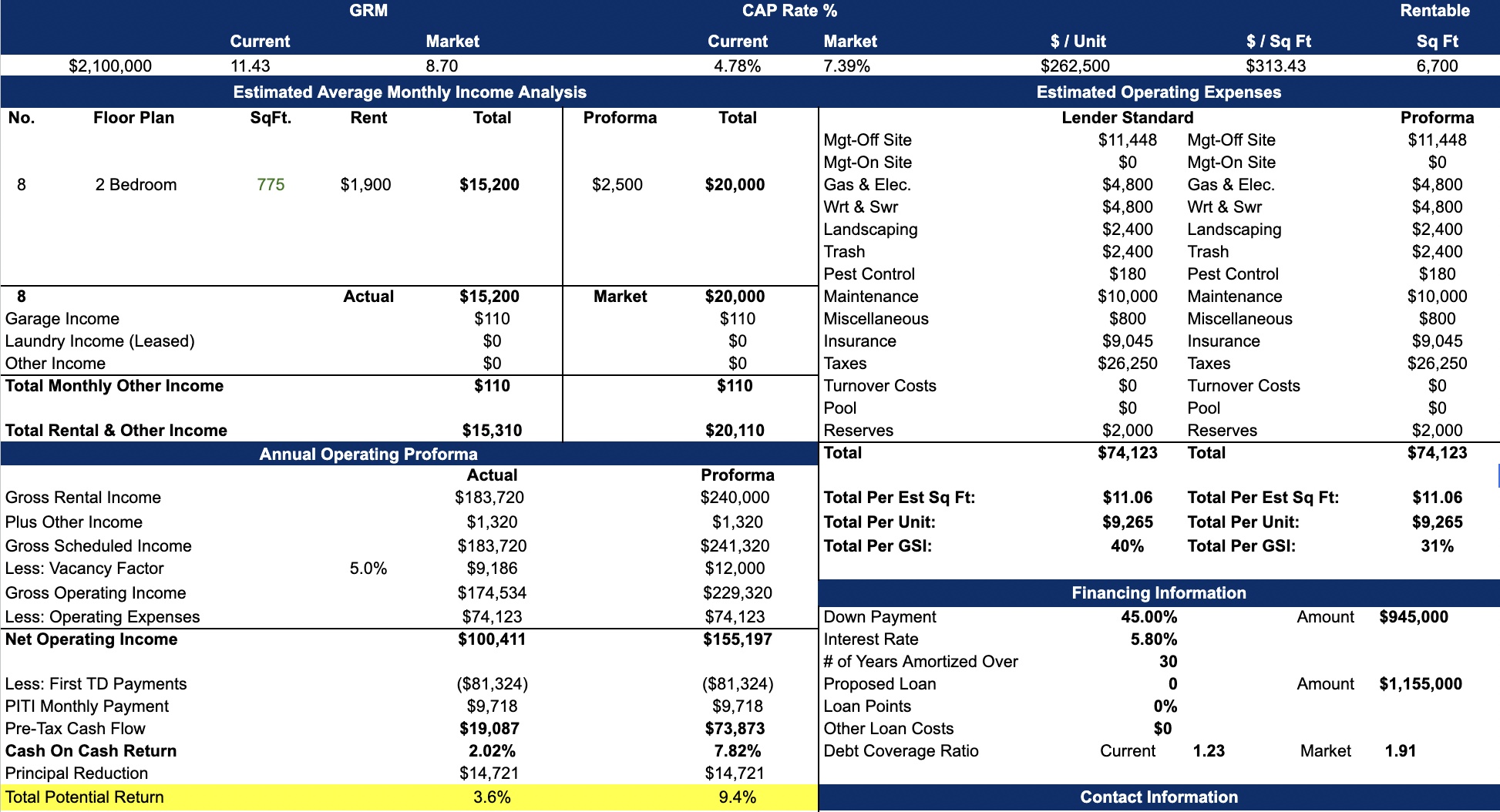
Scenario 1 – Under-Market Rents
8 2 bedroom units × $1,900
Value: $2,100,000
DSCR: 1.23
$262,500 per unit
Scenario 2 – Market Rents
8 2 bedroom units × $2,500
Value: $2,900,000
DSCR: 1.29
$362,500 per unit
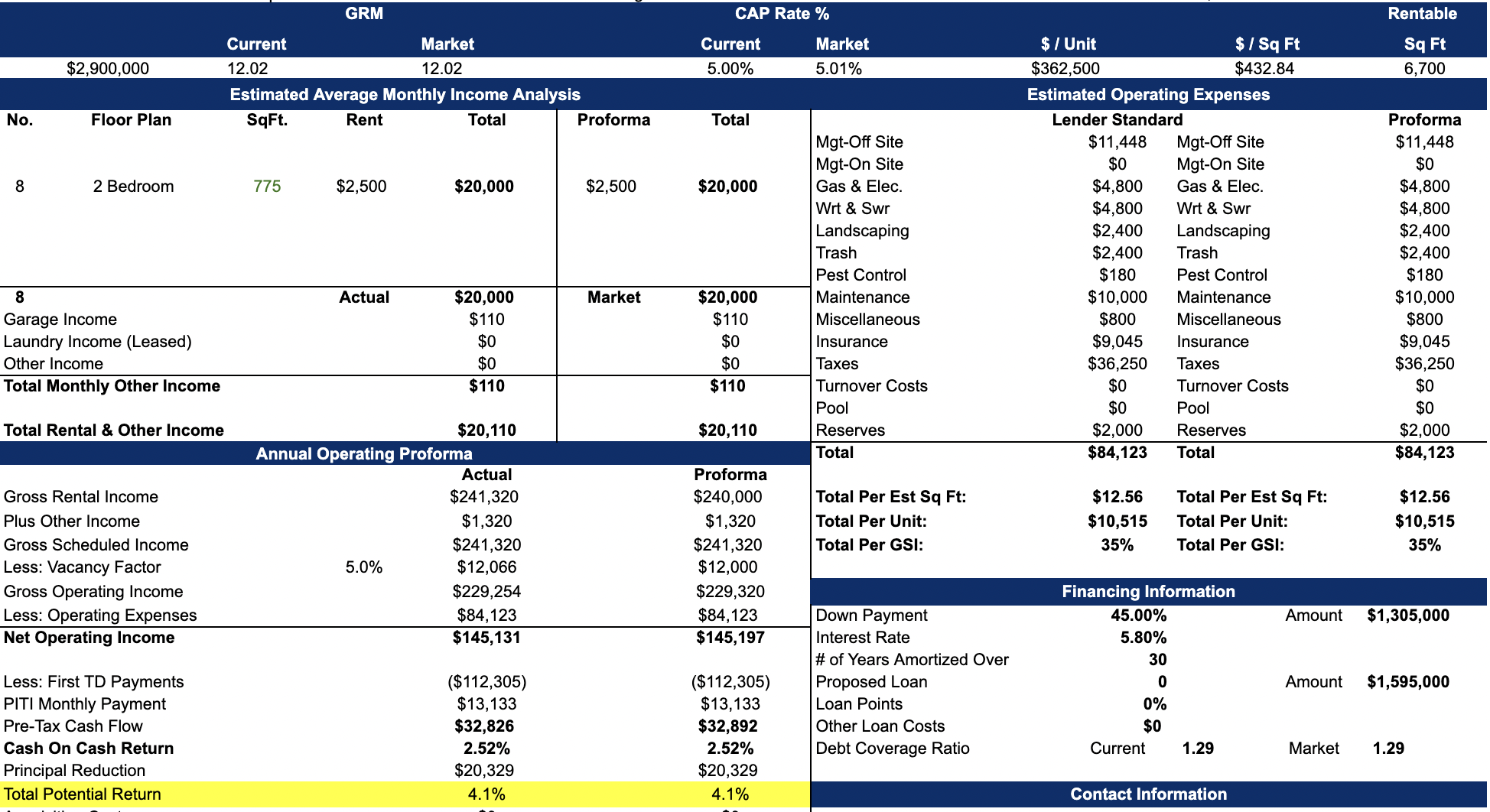
That’s an $800,000 difference in financeable valuation — driven purely by income.
In today’s underwriting climate, Gross Scheduled Income and price-per-unit are carrying the most weight in valuation. Valuations are never based on one variable alone. Area trends, recent comparable sales, capital improvements, and asset class all play a role. However, in every market report we produce, pricing ranges can vary widely and GSI plays a major role in this.
This Is Not Anti-Management
Property managers serve an essential role. Most are focused on operational stability and risk mitigation which absolutely matters. But operational success does not automatically equal strategic value maximization. In many cases, managers are executing within the parameters owners set. If an owner doesn’t request rent audits or push for market alignment, inertia can set in. This isn’t about blame. It’s about alignment.
Owners deserve to understand:
Where their rents truly sit relative to demand
How lenders view their income
How buyers will price their building
What a 3–5 year plan could add
And what selling now could achieve
You Have Two Strategic Options
Option 1: 3–5 Year Alignment Plan
If you’re holding long-term, a structured rent audit and turnover strategy can:
Strengthen DSCR
Improve price-per-unit metrics
Protect against lender scrutiny
Position you for a stronger exit
Option 2: Maximize Value Now
If you’re not interested in waiting years for rental increases and turnover, that’s completely valid.
Selling now, with the right positioning strategy, can still unlock significant value.
Many owners don’t realize that how you present to the market can materially impact your outcome. Without a proper marketing strategy, that encompasses the bullert below, your property won’t even maintain its current value.
In-place income
Market upside
Demand data
Buyer pool targeting
Loan structure realities
With proper positioning, negotiation strategy, and buyer targeting, you can often achieve stronger pricing today, without waiting 3–5 years to adjust rents.
The Takeaway
If you own multifamily buildings in San Diego, you should know:
Where your rents should be
How lenders are underwriting your building
And whether your current strategy aligns with your exit goals
This is about control.
Not panic.
Not criticism.
Not discouragement from selling.
It’s about making informed, strategic decisions.
Want to See Where You Stand?
At ACI Apartments, our valuations aren’t just a number.
We model:
Current performance
Market rent positioning
DSCR impact
Down payment realities
Buyer pool strength
Immediate sale strategy vs long-term optimization
Whether you plan to hold or sell now, you should know your position.
Fill out our valuation form here: FREE CONFIDENTIAL VALUTION
The difference between operational stability and strategic value can be hundreds of thousands of dollars and it comes down to a proper San Diego apartment valuation strategy.